Treatment & care / Melna Oncology Centre
Targeted Cancer Therapy
Treatment guided by the characteristics of the cancer.
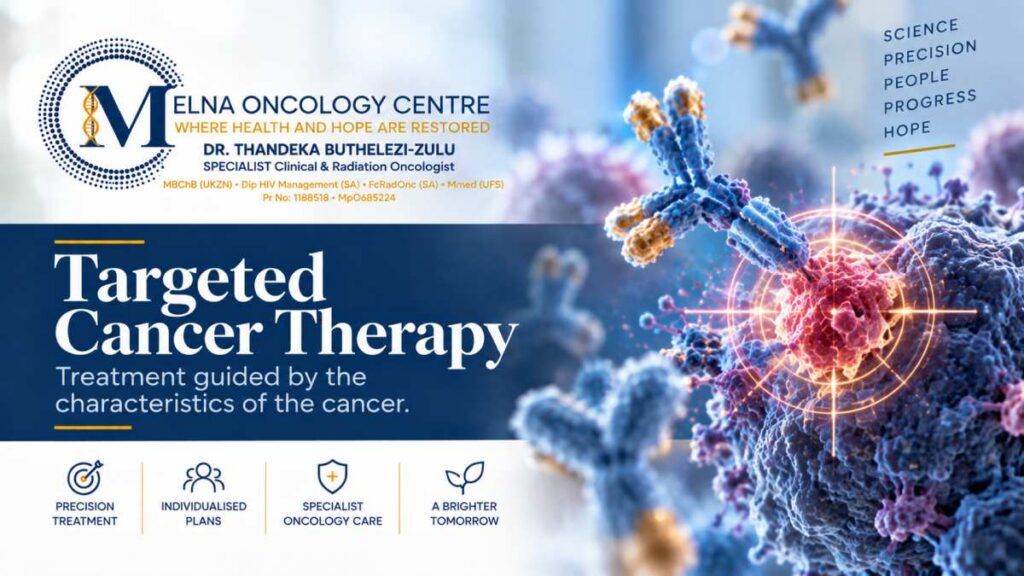
Treatment guided by the characteristics of the cancer.
Targeted cancer therapy uses medicines designed to act on particular molecules, proteins or biological pathways involved in the growth and survival of certain cancers.
Unlike treatments that are selected primarily according to where a cancer developed, some targeted therapies are chosen because testing has identified a particular characteristic of the cancer that the treatment is designed to target.
At Melna Oncology Centre, Dr Thandeka Buthelezi-Zulu, Specialist Clinical & Radiation Oncologist, considers the individual characteristics of each patient’s cancer when assessing whether targeted therapy may form part of their treatment.
What is targeted cancer therapy?
Cancer develops because of changes that affect how cells grow, divide and behave.
Although two patients may have cancer originating in the same organ, the biological characteristics of their cancers may be different.
Targeted therapies are designed to interfere with specific processes that certain cancer cells rely on to grow, survive or spread.
Depending on the treatment, this may involve targeting a particular protein, receptor, genetic alteration or signalling pathway.
This is one reason modern cancer treatment increasingly considers not only where a cancer started, but also how that particular cancer behaves biologically.
How does targeted therapy work?
Different targeted therapies work in different ways.
Depending on the medicine and the cancer being treated, a targeted therapy may:
- Block signals that encourage cancer cells to grow or divide
- Interfere with particular proteins or receptors
- Act on cancer cells with specific molecular characteristics
- Interfere with processes a tumour uses to support its growth
- Deliver treatment to cells carrying a particular target
The exact mechanism depends on the treatment being used.
Targeted therapy is therefore not a single treatment but a broad group of cancer medicines.
How is targeted therapy different from chemotherapy?
Chemotherapy and targeted therapy are both forms of systemic cancer treatment, but they generally work in different ways.
Chemotherapy uses medicines that interfere with the growth and division of cells and can affect both cancer cells and healthy cells.
Targeted therapy is designed to act on particular molecular or biological features involved in a cancer.
However, the word “targeted” does not mean that the treatment affects only cancer cells or causes no side effects.
Healthy cells can share some of the same biological pathways, and targeted therapies can therefore cause side effects that require monitoring and management.
Neither approach is inherently better than the other. The appropriate treatment depends on the individual cancer and patient.
Biomarker and molecular testing
Before some targeted therapies can be considered, the cancer may need to be tested for particular biomarkers or molecular characteristics.
Depending on the cancer, this may involve examining tumour tissue, blood or other appropriate samples.
Testing may look for particular:
- Gene alterations or mutations
- Proteins
- Receptors
- Molecular pathways
- Other biological characteristics
The tests required depend on the type of cancer and the treatment being considered.
Not every patient requires molecular testing, and not every identified alteration has a targeted treatment available.
Dr Buthelezi-Zulu can explain whether this type of testing is relevant to your diagnosis.
What does a biomarker result mean?
A biomarker is a measurable biological characteristic that can sometimes provide information about a cancer.
Certain biomarkers can help oncologists determine whether a particular treatment is more or less likely to be appropriate.
For example, some breast cancers have particular hormone receptors or increased amounts of a protein called HER2. Certain lung cancers may contain specific genetic alterations that can influence treatment decisions.
These are only examples. Testing and treatment recommendations depend on the individual diagnosis.
A positive biomarker result does not automatically mean that a targeted therapy will be appropriate or effective. The result must be considered together with other clinical information.
Which cancers can be treated with targeted therapy?
Targeted therapies are used in the management of a growing number of cancers.
These can include certain:
- Breast cancers
- Lung cancers
- Colorectal cancers
- Melanomas
- Kidney cancers
- Ovarian cancers
- Prostate cancers
- Leukaemias and lymphomas
- Other cancers with particular molecular characteristics
Not every patient with one of these cancers will be suitable for targeted therapy.
Eligibility depends on the particular cancer, its stage and characteristics, available biomarkers, previous treatment and other clinical considerations.
How is targeted therapy given?
Targeted therapies can be administered in different ways.
Some are taken orally as tablets or capsules, while others are given by intravenous infusion or injection.
Treatment may continue for a defined period or for as long as it remains appropriate and is being tolerated, depending on the particular medicine and purpose of treatment.
Your treatment schedule and monitoring requirements will be explained before therapy begins.
Can targeted therapy be combined with other treatments?
Yes.
Depending on the cancer, targeted therapy may be used on its own or together with other treatments.
These may include:
- Chemotherapy
- Radiotherapy
- Immunotherapy
- Hormone therapy
- Surgery
Treatment may also be given in sequence, with different therapies used at different stages of care.
The appropriate combination and timing depend on the individual diagnosis.
What side effects can targeted therapy cause?
Targeted therapies can cause side effects, although these are different depending on the medicine and the pathway being targeted.
Possible effects with some targeted treatments can include:
- Tiredness or fatigue
- Diarrhoea
- Nausea
- Skin rash or other skin changes
- Mouth problems
- Changes in appetite
- Changes in blood pressure
- Changes in liver function
- Effects on blood cell counts
- Changes to hair or nails
Certain targeted therapies can cause other, more specific side effects.
This list does not apply to every treatment.
Before starting therapy, your oncology team will explain the side effects associated with the particular medicine being recommended and which symptoms should be reported.
Monitoring during targeted therapy
Regular monitoring is an important part of targeted cancer treatment.
Depending on the medicine, this may involve:
- Clinical assessments
- Blood tests
- Blood pressure monitoring
- Imaging
- Heart or other organ-function assessments where appropriate
- Monitoring for treatment-related side effects
Monitoring helps your oncology team assess how you are tolerating treatment and whether the cancer is responding.
Treatment may sometimes need to be interrupted, adjusted or changed according to these findings.
Can cancer become resistant to targeted therapy?
Sometimes.
Cancer cells can change over time, and a treatment that initially controls a cancer may eventually become less effective.
This is known as treatment resistance.
If there are signs that a cancer is no longer responding to treatment, further assessment or testing may sometimes help guide the next treatment decision.
This does not necessarily mean that there are no further treatment options.
Dr Buthelezi-Zulu will discuss appropriate next steps according to the individual circumstances.
Precision does not mean certainty.
Targeted therapy represents an important development in cancer treatment because it allows treatment decisions for certain cancers to be informed by their biological characteristics.
But targeted treatment is not appropriate for every cancer, and identifying a molecular target does not guarantee that a particular medicine will work.
The aim is to use the available clinical and biological information to make a well-informed, individualised treatment decision.
Patients should understand what has been identified in their cancer, why a particular treatment is being considered and what the potential benefits and risks may be.
Discuss targeted cancer therapy with Dr Buthelezi-Zulu
If targeted therapy has been recommended as part of your cancer treatment, molecular testing has identified a potential treatment target, or you have been referred for specialist oncology care, you can request a consultation with Dr Thandeka Buthelezi-Zulu at Melna Oncology Centre.
Melna Oncology Centre
Medicare Medical Centre, Suite 12
85 Bird Street
Newcastle, KwaZulu-Natal
Telephone: 034 317 3460
Mobile & WhatsApp: 063 037 3819
Email:admin@melnaoncology.co.za
Request a Consultation
This is general patient information. Your oncologist will explain whether a treatment is appropriate for your diagnosis and circumstances.
The next step
We’re here to help you move forward.
Discuss your diagnosis and treatment options with Dr Buthelezi-Zulu and the Melna Oncology team.